There are few flowers as breathtaking and timeless as peonies. With their large, ruffled blooms and beautiful fragrance that fills the air, they bring an unmistakable sense of romance and beauty to the garden each spring. Although peonies look luxurious and elegant, they are surprisingly hardy and easy to grow once established. Whether planted in a cottage garden, flower bed, or cutting garden, peonies reward gardeners year after year with some of the most stunning blooms imaginable.

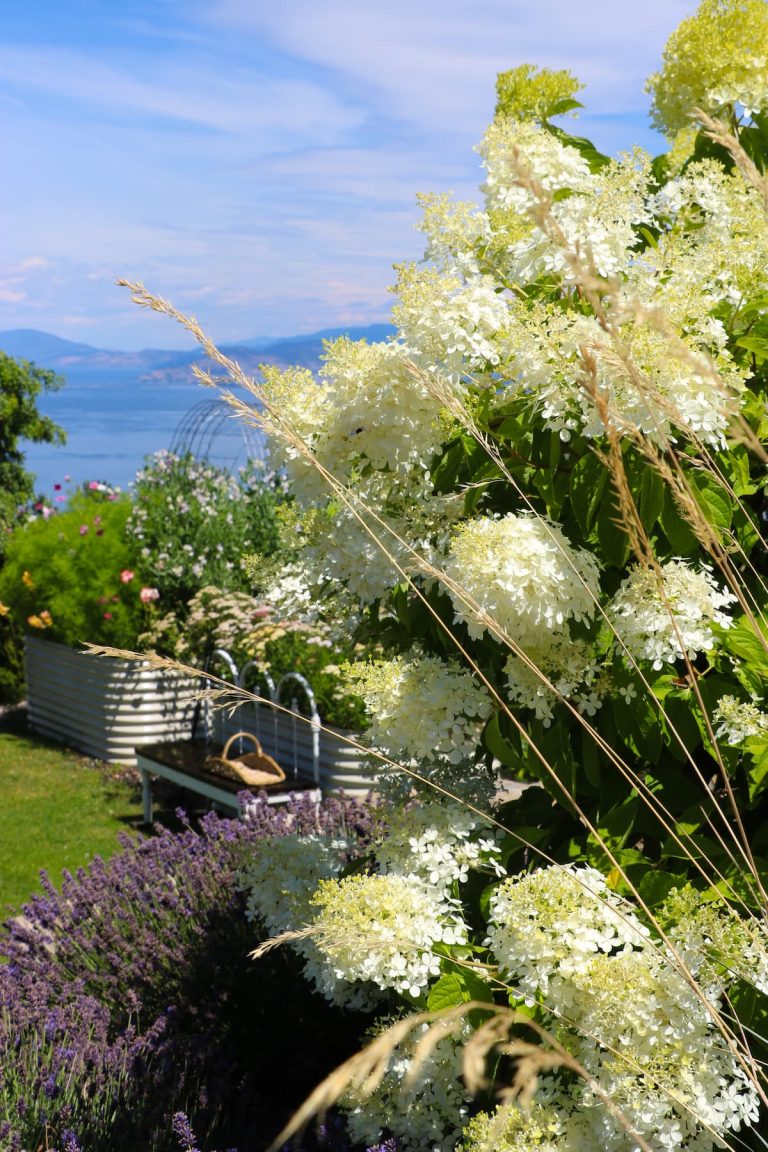
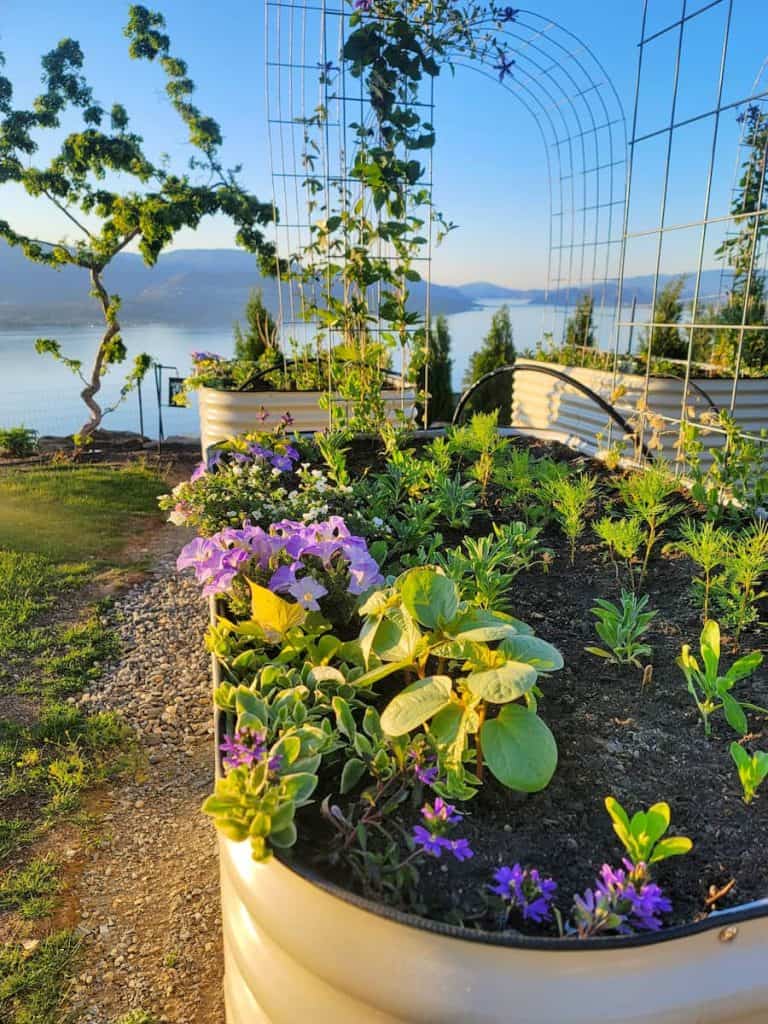
My peonies grow in our courtyard garden on a hillside above Okanagan Lake in Kelowna BC. The courtyard was blasted from solid rock when we built our home and what sits beneath my garden beds is crushed blast rock — the best possible drainage a peony could ask for. Above that is rich soil, organic compost and a fine bark mulch that feeds the plants and keeps the beds looking beautiful.
I have planted peonies at every home we have owned and they have never disappointed me. They are so easy to grow and so easy to care for once they are growing throughout the season, that they make the #1 position on my flower list of the most beautiful but also easiest to grow. That is a very difficult position to reach but they do it effortlessly.

Did you know with the right care they can grow for 100 years? Well they can and you will not need to be a slave to them.
Let’s dive in because today I’m sharing everything I’ve learned about how to grow peonies and why they have become one of my absolute favorite flowers in the garden.
First, let me tell you why I love growing peonies
Oh my goodness there are so many reasons. Where do I even start?
One reason is that I love to photograph peonies! They are so beautiful they almost seem fake. How could one plant create a flower head that has so many different shapes and sizes of petals. Some petals lay out delicately while others are curled like pieces of ribbon, and others are thin and spikey. The variety and number of petals supersedes all other flowers I have in my garden.

Another reason is that their design and appearance is very romantic and feminine. They open up so gracefully and gradually that they are their own little show of days of changing. Petal after petal emerges like multiple layers of a petticoat. Pure femininity in a flower!

The fragrance of a peony is divine. If I could fill my home with the natural scent of a real peony, I would! While they are growing outside, I can smell them from 20 feet away. Their fragrance fills our courtyard and it is pure heaven.

As I eluded to earlier, the blooms go through many phases and I find when I keep them outside in the garden they last a couple of weeks. Once cut and brought inside they do not last as long, but they still last quite long like 5 to 7 days. I hear others can get them to last 10 days and the reason is that they probably cut them sooner than I do.
Speaking of cutting, they are likely the most magnificent cut flower I grow as well. You only need a few to fill a large vase. From every angle a peony is gorgeous so they are also very easy to arrange.
They also make a thoughtful gift for your loved ones.

They are so easy to care for and produce so many flowers in return. They are definitely one of my highest performing flowers with easiest care and they can grow for 100 years. These long-lived plants are a reason alone to have them in your garden because you don’t have to worry about replacing them. There is a peony tree in China that is 1,000 years old – yes you read that right 1,000, not 100, not 10, not 1, but 1,000 years!!!
Deer and rabbits don’t like peonies due to their bitter taste. As we live on the edge of a forest, we have many deer and other animals who frequent our yard. Having something they don’t like the taste of is rare and wonderful!

Lastly, they evoke a feeling of times gone by, better times when life was more simple, slowed down and enjoyed. They give my garden the feeling of cottage garden which is exactly what I am looking for. Soft colors, beautiful scent, interesting shapes and pure girly beauty.
In so many ways, peonies are a garderner’s dream!
Types of Peonies
Before we get into the how-to, let me share the main types of peonies so you can choose which ones are right for your garden. While there are 33 species of peonies they are divided into three different types:
- Herbaceous peonies grow like a bush or mound up to 36 inches tall on green leafy stems. They produce large fragrant flowers and die back to the ground in the winter;
- Tree peonies have a woody stalk and grow between 5 and 7 feet tall. In comparison to herbaceous peonies, tree peonies often have flowers that are larger, bloom earlier and a greater range of colors. They maintain the woody stalk and branches through the winter and do not die back to the ground; and
- Itoh peonies are a hybrid of herbaceous and tree peonies. They have sturdier stalks so they don’t bend like herbaceous but they do die back to the ground. They also offer a larger range of colors including yellow.
Presently, I have 5 peony plants growing in my yard and they are all herbaceous peonies.
Sorbet has very large full blooms and has soft pink petals with white petals interspersed.

Raspberry Sundae is a medium pink with a fluffy center of thin petals and a collar of larger light pink petals.

Monsieur Jules Elie is a deep pink very fluffy peony with many small thin petals that form a kind of pompom.

Shirley Temple has very large flowers with layers of velvety soft rounded petals. They start out light pink and opens to blush white.

I am not sure what the name of this peony is but it could be Moon over Barrington.

If you are looking for a great place to buy peonies online, Peony’s Envy has a wonderful selection (just click here).
Best Place to Plant Peonies
While peonies require less than average care, they do have some very specific needs.
Peonies require a minimum of 6 hours of sunlight per day. I am in zone 6 so my peonies receive full sun for approximately 12 hours a day and love it. If you are in a hotter location, they may require afternoon shade.

I should also mention that peonies do require some cold weather. They require 6 to 8 weeks of cold weather below 45 F/7 C. They do best in zones 3 to 8 but in warmer zones you can choose Itoh or low chill varieties. Here in Kelowna in the Okanagan Valley our warm dry summers and cold winters create ideal peony growing conditions, they absolutely thrive here.
They also require 3 to 4 feet of space between plants because they require good air circulation or else they can be prone to powdery mildew. As I live in a semi-arid area with low humidity, my peonies are growing between irises and hydrangeas with their branches touching and they are doing fantastic. We also have drip irrigation at their base rather than spray overhead irrigation so their leaves do not become wet unless it rains. While they are growing well for me in these less then optimal conditions, I recommend following the guidelines to ensure success.
Lastly, rich, well-drained soil is a must. Peonies do not like “wet feet” ie sitting in wet, soggy clay. In our situation, we had to blast the location of our home and what is now our courtyard where the peonies reside. As such the base is crushed blast rock (well-draining) topped with rich soil. As well, we finished the beds in a fine bark mulch mixed together with organic compost. It makes the beds look finished in a deep color but also feeds them.
Places you should not plant a peony are quite honestly just the opposite of what the best places are. So be sure not to plant a peony in a shady area like under a tree, nor in poor soil like clay, or in areas prone to flooding. Lastly make sure not to plant them where you have sprinkler irrigation due to the potential for powdery mildew but also because water will spoil the delicate petals. Drip irrigation is a better choice.
When to Plant Peonies
The best time of year to plant a peony is fall, in either September or October, but September preferably. Please also consider when your area will receive a hard frost because you will need to get your peony in the ground several weeks ahead of the hard frost. This will allow the roots to get a head start in establishing themselves before winter.
You can plant in spring, but do not expect blooms the first year.
How to Plant Peonies Properly
It is very important to plant peonies properly because if you don’t they may never bloom! This is a mistake made by many.
First, the most critical detail is the planting depth. When you get your plant you will see eyes which are pink or red buds on the roots. Those eyes should be level with the surface of the ground when planted, therefore you do not need to cover the peony with extra dirt.
Make sure that the area you are planting the peony in has great drainage by mixing perlite, pumice or coarse horticultural sand together with potting soil or peat moss. If you are in an area with heavy clay, mix in 2 to 4 inches of organic material.
For the best results, dig your hole 12 to 18 inches deep and twice as wide as the plant. Measure the depth of the pot in which the peony is in. For example if the pot is 6 inches deep and you dug a 12″ deep hole, fill the bottom, 6 inches with your soil and compost mixture. Then take the peony out of the pot and place it in the hole. The soil surface of the plant should be in alignment with the soil surface of the surrounding ground. Fill around the peony with your soil/compost mixture. Do not place any soil mixture on top.
If you are planting more than one peony, be sure to keep the plants 3 to 4 feet away from each other. They do spread out.
If you are planting bare root peonies, make sure that you plant it very quickly after getting it as you do not want it to dry out. Secondly, you will plant it exactly the same as a potted peony (you just won’t need to dig a hole as deep). Make sure the eyes are facing up and are only covered by 1 inch to maximum 2 inches of soil.
Watering
As mentioned earlier, peonies do not like to be flooded or overwatered. They do however, like to be kept evenly moist.

You can check how damp/dry your soil is by pushing your index finger down into the soil. If it dry to your first knuckle or the tip of your finger, then it is time to water again. Newly planted peonies require this consistent watering but established peonies are drought resistant and can do with less watering.
Fertilizing
Fertilizing is only required once a year. You can do this either when you see the new red/pink shoots coming through the ground, or right after the peonies have finished blooming. I do it when the shoots come through the ground.
Use a low nitrogen (first number) fertilizer. It is best to find a fertilizer with one of these ratios 3-4-5, 3-5-5, or 2-5-4.
If the peony is under 2 years old use 2 tablespoons and if it is over 2 years old use 1/4 cup. Sprinkle the fertilizer 3 to 4 inches away from the shoots and then use a trowel to push them into the ground. For a tree peony, use a 1/2 cup of fertilizer.
Bloom Time
Singular peonies generally bloom for 1 to 2 weeks in last spring and early summer, however there are different types of peonies that bloom in early, mid and late season. So if you wish to extend your peony season, plant a variety of types of peonies.


Peonies bloom earliest in warmer areas/zones of the world and then extend northerly into the colder zones as follows:
- Zones 7–8: Mid-April to late May
- Zones 5–6: Mid-May to early June
- Zones 3–4: Late May to late June
- Zone 2: June to early July
Most tree peonies, early heraceous peonies and fern-leaf peonies are considered early season peonies and bloom from late April to early May.
Double herbaceous and Japanese peonies are considered mid-season peonies and bloom from mid to late May.

Late blooming tree peonies and Itoh peonies are considered late season peonies and bloom in late May to early July.
Seasonal Care Tips & Problems
In the early spring, make sure to remove any dead stems that may have been missed last year. As the shoots come up, make sure to fertilize as described above.
As the shoots grow, it is a good time to add a supports for when the plant begins to bloom to support the heavy blossoms. You can get circular one, or half circles like I purchased this year.


In past years, I always got the circular ones, but I found them very difficult to work with. I also found that they squished the stems and did not allow for good air circulation. The half circle ones work perfectly because I find that my peonies only flop in one direction which was towards the sun so I only need to support them up front. Make sure to water as needed.
Once you start seeing round tight balls emerge, you may also see ants or other insects on them. Do not worry, they won’t cause any problems. The blooms have a sticky nectar of sugary droplets on them that the ants and bees are attracted to. Look closely at the photo on the right below and you will see the sugary crystals on the bud.


You may also notice smaller buds to the sides of the main large bud. If you would like larger blossoms, be sure to remove those smaller buds. It will result in fewer blooms but I have noticed that often those smaller buds don’t end up opening anyhow or they are covered by the main large blossom.

During bloom time, check on the supports and continue to water as required.
If you notice any powdery mildew, be sure to spray the leaves throughly with a powdery mildew spray or mixture of 1 ounce of Neem oil and a teaspoon of mild dish soap. You can also make another mixture by combining 1 gallon of water and 1 tablespoon each of canola oil, baking soda, and dish soap in a spray bottle. Whichever solution you decide to try, you will need to spray the leaves thoroughly. Make sure that any clippers you use on an infected plant are properly cleaned before using them on another plant. It is important to treat powdery mildew as it will affect the health of the plant.
When the peony flowers have finished blooming be sure to remove the flower (deadhead) and stem down to the first set of leaves. Make a 45 degree angle cut. It is important to leave the stems and greenery on as it helps with photosynthesis and the health of the plant.
In the autumn, cut the foliage down to the ground and remove. You can apply a small amount of mulch over the crown of the plant for winter protection.
The Most Asked Peony Question Answered
I bet you have already guessed what the number one reason is that peonies may not bloom – yes, it is because they are planted too deep. Be sure to plant a potted peony level to the soil line and a bare root one to two inches below the surface of the ground.
It could also be because they are in a soggy area and have rotted.
Or they may not be getting enough direct sunlight.
They could just be young and getting established. If you planted them in the spring, they may take a year to bloom.
Cutting Peonies for Flower Arrangements
The best time to cut peonies to bring them inside is when the peony buds are still round and are squishy like a marshmallow. If you cut them too soon, they may not open and if you cut them too late, they will have a shorter vase life.
Remove all greenery because the greenery will only suck up the water the flower requires and could bring bacteria into the water.
Cut the stem of the peony on a 45 degree angle so that it has a long surface to draw the water up from.


Place in a large vase with warm water (not hot, nor cold, just warm).
Make sure to use a large enough vase to support the stems. Do not overcrowd as peonies will open up very large and they still like airflow.
It is also a good idea to place a grid of tape on the top of your vase to hold the stems apart. Peonies can be quite heavy and need all the support they can get.

Change the water every 2 days and trim the ends of the stems each time.
If you follow all of these points, you can get 5 to 10 days of vase life.
Peonies are one of the most spectacular cut flowers and make wonderful arrangements. After you provide property support, they do the rest and put on the most amazing show of ruffles.

Refrigerator Storage Technique
You can also store peonies in the fridge for 1 to 2 months by picking them at the marshmallow stage, stripping all foliage, wrapping them in newspaper or craft paper, then wrapping and sealing them in a plastic bag. Make sure to lay them horizontally on a shelf. When you would like to use them, unwrap them, cut their stems on a 45 degree angle and put them in luke warm water. They will rehydrate in 24 to 48 hours.
Dividing Peonies
While you do not have to divide peonies, if you wish to it is quite easy. In the fall, remove all of the foliage. Then dig up the entire peony and divide the roots into sections with a minimum of 3 to 5 eyes/buds each. Then replant them as you would a new peony plant.
Companion Flowers for Peonies
I grow my peonies alongside irises, delphiniums and hydrangeas and the combination is absolutely stunning — the irises bloom just before the peonies and the delphiniums and hydrangeas carry on the show once the peonies have finished, giving me continuous colour from late spring through summer.

You could also pair them with roses, lavender, allium, foxgloves and ranunculus.

If you would like to see my entire garden through the months of the year, click here for my garden tour.
Why Peonies are the Perfect Flower for a Cottage Garden
There is something about a peony that belongs in a cottage garden the way a climbing rose belongs on a picket fence, as if it could not possibly grow anywhere else. The soft billowing blooms in shades of blush, cream and deep pink. The heady fragrance drifting through warm summer air. The way the petals seem to flutter even when there is no breeze. It all speaks the language of romance and simplicity that defines a true cottage garden.

A cottage garden is not about perfection or rigid symmetry. It is about abundance, beauty and the feeling that something wonderful simply grew there on its own. Peonies embody all of that effortlessly. They ask for very little, give back extravagantly, and fill every corner of the garden with a softness and femininity that no other flower quite achieves.

If you are dreaming of a romantic cottage garden — one that makes you catch your breath each morning when you step outside — begin with peonies. Everything else will follow.
Peonies with their fragrant blooms are the heart of my cottage garden at Sweet Valley Acres. I look forward to them blooming each and every year!
In Closing
Every spring when my Sorbet peony opens its first bloom in our secret garden-like courtyard, I am reminded that some of the most beautiful things in life simply need time, good roots and a little patience.

Peonies are one of those rare flowers that somehow manage to feel both elegant and effortless at the same time. Their soft petals, incredible fragrance, and timeless beauty make them a true highlight of the garden each year. While they may require a little patience in the beginning, once established, peonies reward gardeners with decades of breathtaking blooms and unforgettable spring beauty. Whether you grow them for bouquets, cottage garden charm, or simply the joy of seeing them bloom, peonies are truly a flower worth making space for in every garden.