Welcome to my Zone 6 garden tour! We are at the end of summer and my flower gardens are in full bloom. I am located in Kelowna, British Columbia Canada in a semi-arid zone with hot and dry summers (30+ degrees C/86+ F) and winters that can dip into the low -20’s C/-4+ F although usually not for a long period of time. Our springs can be a bit wet and dreary but our falls are usually spectacular with lots of sunny days and mild temperatures. These fluctuations in temperatures allow me to grow flowers that require cold stratification like tulips, peonies, delphiniums, coneflowers and poppies. With careful planning my garden has blooms beginning as soon as the snow recedes until late fall.
Come along and tour all of my garden areas. I thought it would be informative to show what was blooming month by month to give readers ideas of how to have blooms throughout the year. From November through February, we usually have snow so I will be covering from May through to October.
Zone 6A/B
I live in Kelowna, BC Canada and our area ranges from 6A to 7A, but I am going to focus on the Zone 6 rather than 7. Our winter lows can reach -23C/-10F. Now and then we can have a short period of time that could get a bit colder but generally we see about a week in the -20’s and the rest of the time we are around freezing to -10C/14F.
Our last potential day of frost ranges from May 8 to 19. It is rare that we actually have frost or dip below freezing in May, but just to be safe, most people wait to put their tender seedlings out until after those dates.
Growing from Seed
While nothing is blooming in my garden in January or February, this is a perfect time to get a head start on the season and plant seeds indoors. I use metal racks with grow lights set with a timer for 12 hours of light a day to start my seeds in seed trays. This year I grew:
- a wide variety of zinnias, poppies & cosmos
- snapdragons
- dahlias
- sweet peas
- straw flowers
- pincushion flowers
- delphiniums
- love-in-a-mist
The way to know when to start your seeds is to research what the last frost date for your area is and then look at the number of “days until maturity” and count backwards on the calendar. That will give you the date to get them started.
You may also want to look into a heat mat to keep the seeds that need a consistent soil temp to germinate.
March – Early Bloomers
The very first blooms in my garden are these sweet little crocuses. They start around mid March and that is almost two months before the last frost date in my area.

You may think while you are waiting for the last frost date to pass that this might be a good time to clean up debris from last year but that would be incorrect. Leave the debris (leaves, old plant material, etc) in your beds because this is where your pollinators (bees, butterflies and moths) may be overwintering. I leave it until I see the first signs of bees flying around my garden which is usually in April.
April – Spring is here!
Near mid to late April the fruit trees start blossoming. We have an ornamental plum tree, a nectarine tree and a multi grafted fruit tree that grows yellow and red plums, all of which are so delicious.


Hyacinths also pop up at this time but unfortunately I could not find a single picture of them. Trust me they are a gorgeous deep purple and so fragrant!
May – The Flower Garden Comes to Life
In early May, my very special clematis vine that grows what looks like the sweetest little pink ballerina tutu’s starts blooming. It is called Macropetala Markum Pink Clematis or a Downy Clematis. It is unique and blooms a few times throughout the summer as well.
It’s blooms also press very well so if you are looking for blossoms to press, this one is perfect.

After that the daffodils bloom. I find daffodils to be easy-care spring flowers because I have them in several areas and some areas do not have great soil and yet these early spring flowers come up every year!

One of my favorite spring flowers is this delightfully pretty soft pink lilac bush. I also have other purple lilacs which bloom several times throughout the spring and summer however their later blooms are far less than the spring flowering season. If you love purple flowers, consider planting lilacs. They also are wonderful to bring inside because their fragrance will fill your home.


Pink rockcress cascading over our rock retaining walls is a stunner!

A short time later, the allium all start forming and opening up.


Irises are next and I had a very interesting and rate phenomenon happen this year. I had an iris mutate. The purple iris on the left morphed into the soft lilac iris on the right. I could not believe it but I looked back in photos and in the exact spot that the fully purple iris with striped green and yellow leaves was, this year it came up as soft lilac, was much larger and had fully green leaves.
What happened in my garden is a spontaneous mutation or a sport. It is an abrupt genetic change in a plant, causing it to produce an offset (a new growth from the main plant) that is different from the parent. Other reasons for mutations can be from chemical damage, environmental stress such as extreme temperature changes, overcrowding or transplanting errors. None of these possibilities occurred so I am the lucky gardener with a spontaneous mutation! Isn’t that interesting?


Cornflowers are next and they are so interesting. I have a large patch of pink coneflowers that get masses of beautiful blooms that are quite longlasting. In late summer they send up a few more flowers but not nearly as many as in spring.

I also have this unique amethyst one.

Then later in May one of my all time favorite flowering shrubs starts to bloom and it is the snowball bush. I grew up with a snowball bush and it was huge. I actually thought it was a tree because it was at least 12 feet tall.
I grew up in an area where we didn’t get a lot of snow and it was such a spectacular event when it happened that I craved for snow. So the snowball bush that bloomed in our front yard meant so much to me. When we moved to the property we are currently on, I found snowball bushes at our local nursery and bought them. I would like to plant them all over but unfortunately the deer love to eat them so I can only grow them in the fenced areas.

In late May, the peonies come up in all their glory and they continue to bloom into early June.

Peonies are one of my favorite spring flowers because they are easy to grow, the come in a variety of shapes and colors, they are great for a cut flower garden because they make great cut flowers.


June – Somewhere between a spring and summer garden
In Kelowna, May can be quite warm and then June will cool down a bit and can be quite rainy. June is a month where the garden really starts to come into it’s own with lots of beautiful blooms.
For example the tall spikes of blue and purple delphiniums that I have growing in many spots.

A very unique tree which is called Twisty baby or Black locust also gets in the game and produces masses of pretty fragrant flowers.


I adore the shape of this tree and it is perfect set against the backdrop of the Okanagan Lake.

A delicate flower that is so charming and has an old-fashioned feel to it is the California Poppy Thai Silk Pink Champagne.

Climbing roses are next. Eden rose is the first one that starts blooming in my garden and it is one of my favorite flowers. The ball shaped, multi-petal blooms are old fashioned, lush and last a long time.


This climbing rose used to be pink, but after a few harsh winters the rose that was grafted onto the root died. This year the rose took off and climbed over my arbour and down the trellis. I was so excited and then shocked when the blooms were this deep red. It was then that I learned what had happened about the root rose taking over. It is likely that this is a Dr. Huey rambling rose as this rose variety is used by commercial growers to graft other types of roses onto.

Another climbing rose that has managed to survive the winters is this beauty and this year it bloomed abundantly. I love how the soft yellow honeysuckle has intertwined with it.

If you are looking for a flower that will self seed, then consider poppies. They are sun-loving plants and have a long growing season. I find that mine bloom from June through August.


Another great self seeding flower is Yarrow. The one below is called Summer Berries. It blooms for a few months and is also wonderful to dry and use in flower arrangements.

Lavender grows very well in our hot dry climate. I usually get two harvests off of it and of course the bees love it!

At the very end of June, the daisies start making an appearance and they will continue to bloom right through July.

July – when the garden begins to peak
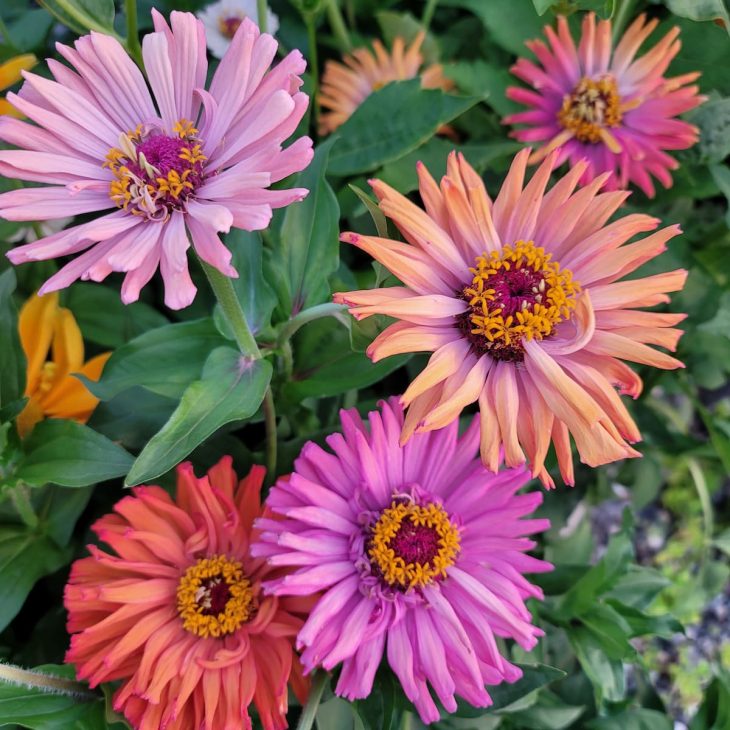
Zinnias truly are my new favorite flower to grow from seed. Their blooms are so long lasting and they come in a variety of colors.
The ones below are called Agave. This is the first year I have grown the and they are phenomenal if you are looking for colorful blooms in your backyard or front yard or even your side yard!
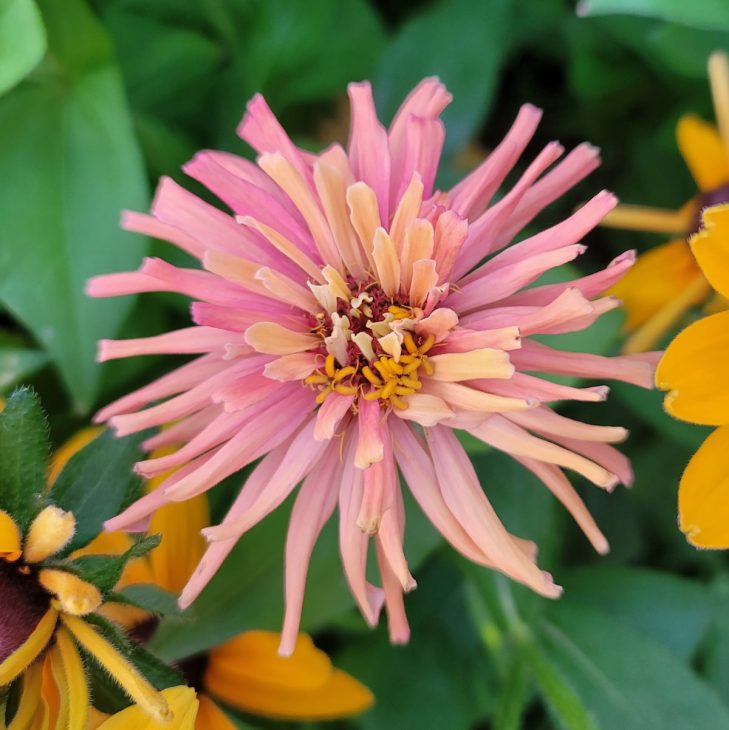
This is a Ballerina zinnia and I have fallen in love. The pale blush petals and the abundance of petals is outstanding. They also basically dry on the stem and look good for at least a month. No lie. Perhaps it is our dry warm weather but these flowers just keep looking beautiful.

They also have a very long growing season. Mine last until the first frost hits. Last fall I had zinnias blooming in my garden right through October.

If you are thinking of creating a cutting garden, I would recommend adding zinnias to it.
Hydrangea have always been a favorite flower of mine since I was a little girl. These days my favorite variety is panicle hydrangeas. They are also known as peegee hydrangeas, hardy hydrangeas and limelight hydrangeas.
The blooms are enormous and they start out as a greenish white, turn white and then finish off in the fall as a dusty rose. They dry very easily and can be used in arrangements for years.
I highly suggest adding them to your garden they too will become a favorite addition for you!

Snapdragons typically start blooming in spring, but mine were late this year and did not start to bloom until July. They also self seed so I find them growing in lots of beds there were not planted in and also in pathways. But look just how beautiful they are during the golden hour.

Sweet peas are very nostalgic for me as my grandfather used to grow them. This year was a stellar year for growing sweet peas and they actually formed tunnels in my raised bed garden. They were dense and so fragrant, especially in the early evening.


If you are looking for an abundance of yellow flowers during the summer, add Prairie Sun Rudbeckia to your garden beds. They self seed and are quite hardy. Even in small raised garden beds, they made it through some very cold winters and came back strong the next year.

I have a love/dislike relationship with dahlias. Mostly I love them, but I do dislike how finicky growing them from tubers can be. In my zone they must be taken out each winter, carefully cared for and then you need to wait for them to grow eyes and then replant them. Then wait and wait to see if they bloom. But if they do, then you will fall in love.
This is one of my favorite dahlias that I grow from a tuber and it is called Breakout. It starts as this pale creamy blush and fades to a full creak large flower. This particular variety produces an abundance of blooms.

This is how it looks as it ages – more cream and less blush.

The other option with dahlias is to grow them from seed and this is much easier. The only thing with growing from seed is that you will never really know what it is going to look like as they come in a wide variety.
From the same seed packet I grew this one…

And this one…

And this one.

Isn’t the variety amazing? What is even more fun is that now you can name the dahlias you grow from seed with a name you create and save the tuber for next year!
August – when the flowers reach their crescendo
The early sunflowers started to show up in early August and what a treat it is to see their bright happy faces rise above the rest of the flowers.

By August, Cosmos is filling my garden with color and motion. I love how they bob in the wind and if you keep cutting the spent blooms, more flowers will bloom.

The most unique flower I have in my garden is celosia. It comes in many different shapes and this version reminds me of a coral reef.

Here is what one area of my garden looks this time of year with hydrangea, zinnias, sunflowers and dahlias all blooming!

September – The beginning of the decline
At this time of year my garden is filled with zinnias, dahlias, sunflowers, hydrangea, sweet peas, cosmos, celosia, rudbeckia and even another flush of delphiniums blooming.
One new flower at this time, is Lace flower (color: Lacy Blue). It seems to take longer, or at least it did for me this year. I love these flowers which are one head filled with multiple little blooms forming a circle. This flower is great for drying.

More sunflowers are blooming and turning to seed for the birds and chipmunks.

The dahlias that take a little longer to bloom begin filling up the garden.


Here is a new dahlia that I have recently added to my garden and it’s name is Apple Blossom.

Here is another view of my garden showing white hydrangea, lavender, dahlias and zinnias blooming.

Other areas of my garden are as full as they will get, like our courtyard with a most healthy wisteria vine planted over our trellis along with maples and a variety of hydrangea.

October – The last of the blooms
At this point the garden is winding down for fall and winter. The trees begin to turn to yellow, red and orange. The flowers that take the longest to bloom, send out their blossoms and this includes the dahlia named Labyrinth. It is one of the most exquisite flowers I have ever grown.

Cosmos is still going strong!

In October, I incorporate potted mums into my garden along with pumpkins and cornstalks.

Later, the trees begin to turn to their vibrant fall colors.

Before & Afters
To give you an idea of how the garden progresses from early spring, through summer and into fall here are before and after photos.
The once bare raised garden beds are filled with sweet peas, zinnias, cosmos and dahlias.


The bare tiered garden transforms into a tailored garden filled with a variety of hydrangea, grasses, lavender, and other flowers.


The round raised garden erupts with a vibrant yellow display of rudbeckia and zinnias.


The greenhouse garden goes from bare to overflowing with pink flowers.


In closing…
My garden brings me:
joy
peace
happiness
relaxation
energy
love
life
a belief in a better day tomorrow.
I share all of this with you, in the hope that it brings you all of these too!

If you liked this, you may like this
Here are some similar posts that my other readers have been enjoying.
14 Reasons I love Zinnias, just click here.

How to dry flowers and projects to create with them, just click here.

Looking for some shopping ideas?
Below are shopping links to garden products I either have or would love to have in my garden. As an Amazon affiliate, I earn from qualifying purchases at not extra cost to you. I appreciate your support of buying through my links.

Thank you!
Thank you for sticking around until the end. Please leave a comment as I would love to hear from you!


Thanks for all the lovely photos
You are so very welcome! Thank you for your sweet comment!
How lovely, thanks for the tour! I came to you from HomeTalk.com. I have a ton of irises and love them when they bloom in the spring. Sadly, I do not have a lot of flowers in my gardens. I am more of an herb and vegetable gardener, and I have planted lots of trees on our property in Southeastern Pennsylvania. Do you recommend a plant food product for flower bushes (I have irises, tulips, and hydrangea on my property) that will help the plants to rebloom more than just once?
Hello Sabrina! Welcome! I am so happy you are here. I am up in Canada and to my knowledge irises and tulips only bloom once in the spring. I have never heard of any that you can get two blooms out of. There are some versions of hydrangea that will bloom twice. You have to look for a hydrangea that blooms on old and new wood and is called “remontant”. Look for Endless Summer, Everlasting and Forever and Ever. Other than that I would try to introduce some smaller plants in between your herb and vegetables if possible that bloom at other times of the years. Maybe some vines would not take up ground space but could grow on a fence or trellis and provide you with blooms. Another option is to add in some pots of annuals here and there in your garden. Thanks for commenting and happy planting!